EN
EN  AM
AM 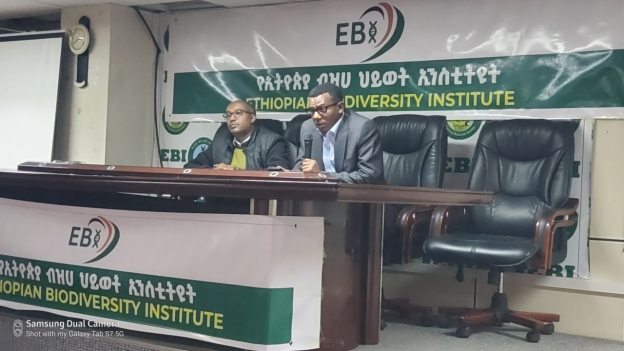
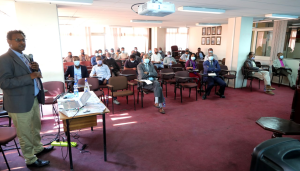
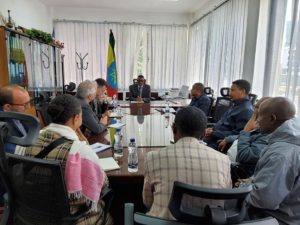
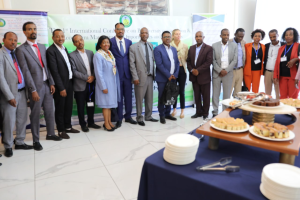
The Ethiopian Biodiversity Institute held its annual research review program from July 29-30, 2025 at the Institute’s conference hall.
Dr. Samson Shimelse, LEO of Training, Consulting, and Project Monitoring and Support, emphasized that our institution aims to be a developmental, transformative, and effective institution by preparing and coordinating the program. He invited Dr. Abiyot Berhanu, the institution’s Deputy Director General, to deliver the welcome and opening speech.
Dr. Abiyot Berhanu also mentioned that the institution has reached its annual research program (Flagship Project) and acknowledged the presence of many researchers. For the next year, the institution plans to operate as a research institution, as its name implies, by bringing resources and people to higher levels of knowledge and ethics. This is a departure from the traditional approach, indicating a future focus on technological advancements.
He added that, the goals and objectives of the institution include solving societal problems, promoting interests, and bringing about tangible change.
The first principle is “Living in harmony with nature,” emphasizing that research results must have a high positive impact and a holistic disciplinary approach.
Dr. Karta Kaske, the director general of the institute, emphasized the importance of research providing tangible results and economic benefits relevant to the institute’s main purpose. Guidelines for evaluation criteria for research projects were provided, focusing on maximizing the beneficial role of biodiversity through available human resources and professional focus points.
Researchers presented their projects over two days, receiving feedback and suggestions for improvement. Dr. Samson Shimelse, LEO of Training, Consulting, and Project Monitoring and Support, ensured that projects were completed and submitted with quality.
Dr. Karta concluded the program by emphasizing the importance of achieving results by adhering to research and development principles. Addressing implementation problems with technology will bring biodiversity closer to the public and government, ultimately enriching the country.